
Analysis / Development
Understand what the development can support.
Development feasibility software for the decisions behind a project. Connect costs, programme, receipts and funding, then compare the monthly cash flow, capital requirements and returns.
Discuss developmentA complete worked example / Foundry Yard
A real decision.
Worked through.
A fictional Manchester redevelopment. Follow the scheme from its first assumptions to a cost alternative, the financial consequence and a finished report.

Define what
you’re building.
96 apartments and 12 sold workspaces, delivered in two phases between January 2027 and December 2030.
Land, construction, sales and finance are stated separately, so the result has something concrete behind it.
Assumed inputs in GBP and m². Fictional project, before tax.- Land + acquisition costs
- £6.09m
- Gross sales
- £41.97m
- Developer equity
- £13.00m
- Loan interest rate
- 6.5%
What is being built?
Base construction total: £25,721,250. Selling costs, professional fees and other allowances are set out in the downloadable review.
What if construction
costs rise by 10%?
The saved alternative raises construction rates and the remediation allowance. The displayed sales, land, equity and loan-rate assumptions stay the same.
Switch between the two cases to see the effect.
Explore the two saved results. These controls do not calculate a new appraisal.Base
- Development profit, after finance
- £2,794,970
- Construction costs
- £25.72m
- Finance cost
- £1.13m
- Peak debt
- £19.65m
- Equity IRR
- 5.71%
A positive profit does not settle the decision: the Base equity IRR is 5.71%, and the project NPV at a 12% discount rate is negative.
The cost increase
doesn’t stop at the build.
The alternative also carries more finance cost. Together, they remove £2.84m from the development profit.
- Extra construction
- +£2,572,125
- Extra finance
- +£264,093
- Reduction in profit
- £2,836,218
| Financial result | Base | Construction +10% |
|---|---|---|
| Development profit | Base£2,794,970 | Construction +10%−£41,248 |
| Peak debt | Base£19.65m | Construction +10%£21.94m |
| Project IRR, before debt | Base6.67% | Construction +10%2.25% |
| Equity IRR | Base5.71% | Construction +10%-0.09% |
| Project NPV at 12% | Base−£2.55m | Construction +10%−£4.76m |
Profit includes finance costs. Project IRR and NPV use project cash flows before debt; equity IRR uses equity cash flows. Peak debt is borrowing outstanding, not the total funding requirement. Figures are rounded for display.
A report with
a traceable starting point.
The case review brings the assumptions, the two saved calculations and the financial consequence together. It includes two selected pages from Foundry Yard’s Base report.
Download the case reviewPDF · 5-page compiled example, including two pages from the Base report and a separate comparison of the cost alternative.
Explore reporting & review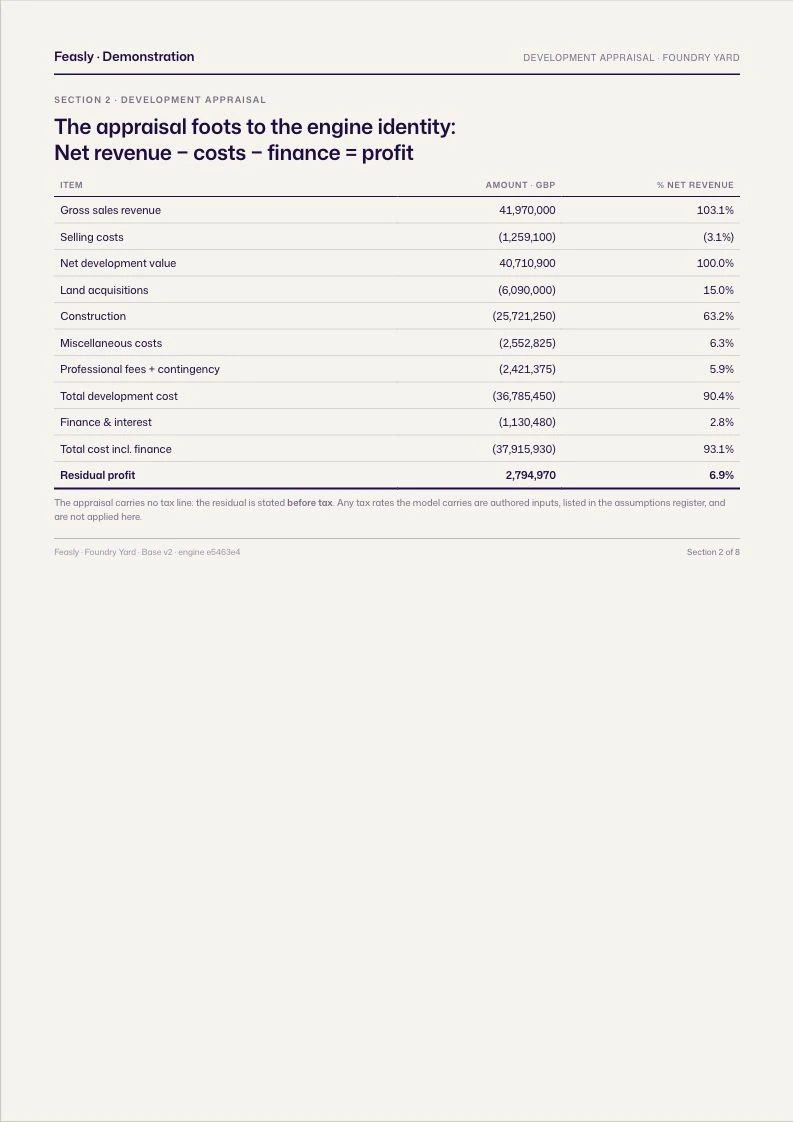 Foundry Yard / Base
 Model the project.
Work through quantities, timing, costs, sales or rental income and funding together. Follow the monthly cash flow behind the result.
Test a different case.
Compare changes to costs, receipts, programme and supported funding structures. Keep the original case available for review.
Look beyond one project.
Our consolidation direction connects related phases and projects to the combined timing of capital and outcomes.
Choosing development feasibility software.
When should I use Feasly instead of building an Excel feasibility model?
Consider Feasly when your development appraisal needs repeated changes to costs, programme, receipts and funding, with a saved base case and alternatives your team can review. The Feasly Calculation Engine connects accepted assumptions to monthly cash flow and returns; the workspace keeps models, scenarios and source documents together. A reviewed Excel model remains a sensible choice for a bespoke structure or a required client workbook. Choose Feasly when its supported methods fit the assignment and you want to spend more time investigating the project than maintaining that calculation workflow yourself.
What does Feasly show beyond development profit?
Profit is only one part of the decision. Examine when costs are paid and receipts arrive, how much capital is required and when it is needed. For supported financed models, examine equity, debt and the effect of funding on returns. Compare a changed case with Base and investigate the assumptions behind the difference. Our fictional UK appraisal demonstrates why the timing matters: a six-month receipt delay leaves nominal profit unchanged but increases the maximum project cash shortfall from £6.77m to £7.80m. That published example is all-equity and before debt finance and corporation tax.
How should I evaluate Feasly alongside my existing appraisal software?
Bring one completed case, its source assumptions and the outputs you rely on. Agree area definitions, timing conventions, cost scope and funding terms, then reconcile the base and a meaningful downside case. Check file compatibility, editable inputs, reports and the review process before committing to a move. Similar headline returns do not establish that two models treat the project in the same way.
How does Feasly compare with EstateMaster, ARGUS Developer and Aprao?
Compare the supported financial methods, the work needed to change and review a case, and the connections your team needs. Our comparisons link to vendor product information and Feasly examples, including a worked appraisal and the ChatGPT private preview. Use a representative project to establish whether Feasly improves the assignment you need to complete.