What to take into your next appraisal
- Underwrite the price, income, ownership costs, debt and exit together. Interest coverage answers only part of the question.
- The base case needs AED 9m of equity. The combined downside returns only AED 6.45m in total operating cash and net sale proceeds to equity over five years.
- Download the assumptions, calculated results and annual cash flows for all four cases.
Try the underwriting scenario demo
Compare the Base, higher-vacancy, softer-exit and combined cases below. The acquisition and debt remain fixed. Trace each selected result from income to equity cash and from sale value to capital recovery.
What happens to your equity?
AED 20m office · AED 9m initial equity · five-year holdChoose a vacancy allowance and exit yield to explore four recorded Feasly calculations. This demo displays saved results; it does not run a new appraisal.
Base
5% vacancy · 7.5% exit yield- Equity IRR
- 9.63% The recorded starting case
- Total cash returned to equity
- AED 13.40m 1.49× the AED 9m invested, over five years
- Year-one interest coverage
- 2.08× NOI / interest; excludes principal repayment
- Property IRR, before debt
- 7.57% Uses property cash flows, including acquisition costs
The starting case pays interest and returns more than the initial equity. It still needs to meet the investor’s return hurdle and withstand downside review.
Year one: rent to equity cash
- Gross rent
- AED 2,000,000
- Vacancy allowance
- AED -100,000
- Operating costs
- AED -400,000
- NOI
- AED 1,500,000
- Interest
- AED -720,000
- Cash after interest
- AED 780,000
At sale: value to equity proceeds
- Year-five NOI
- AED 1,615,096
- Exit yield
- 7.5%
- Gross sale value
- AED 21,534,613
- Selling costs
- AED -323,019
- Loan repayment
- AED -12,000,000
- Net sale proceeds to equity
- AED 9,211,593
Cash bridges use the published independent annual reconciliation, rounded to the nearest AED. Net sale proceeds exclude the final year’s operating cash. Total cash returned includes both, with no double counting.
Inspect the selected case’s annual equity cash flows
- Acquisition
- AED -9,000,000
- 2027
- AED 780,000
- 2028
- AED 808,000
- 2029
- AED 836,510
- 2030
- AED 865,539
- 2031, including sale
- AED 10,106,689
Fictional, pre-tax example. No capital works, reserves, tenant-level lease events or refinancing. Debt is interest-only and repaid in full at sale. IRRs and coverage come from the Feasly Calculation Engine. Explore the assumptions and results.
The acquisition and its assumptions
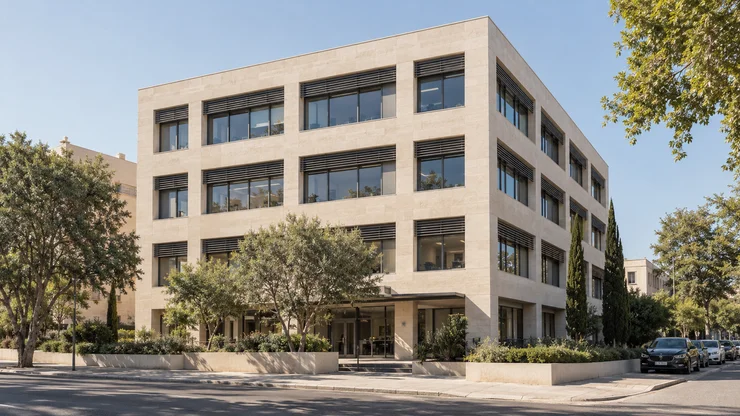
The example is a fictional 2,000 m² office acquired at the start of January 2027 and sold at the end of 2031. Amounts are in AED. The prices, rents and yields are illustrative assumptions, not observations about a particular market. Base and the three alternatives are separate saved cases in Feasly.
| Input | Base assumption |
|---|---|
| Purchase price / acquisition costs | AED 20m / AED 1m |
| Gross annual rent / annual operating costs | AED 2m / AED 400,000 in year one |
| Vacancy allowance | 5% of gross rent throughout the hold |
| Annual growth from year two | Rent 2%; operating costs 2.5% |
| Debt | AED 12m at 6%, interest-only; full principal repaid at sale |
| Initial equity | AED 9m: AED 21m total acquisition cost less AED 12m borrowing |
| Holding period / sale | Five years; capitalise year-five NOI at a 7.5% exit yield |
| Selling costs / property discount rate | 1.5% of gross sale price / 8% annually |
Sources: Feasly: Four office acquisition cases: inputs, engine results and annual reconciliation
First, reconcile rent to cash after interest
Year-one effective rent is AED 1.90m after the AED 100,000 vacancy allowance. Deducting AED 400,000 of operating costs gives AED 1.50m of net operating income, or NOI. The AED 12m loan costs AED 720,000 in annual interest, leaving AED 780,000 for equity before any excluded items.
That gives 2.08 times operating interest coverage and an 8.67% first-year cash-on-cash return on AED 9m of equity. Neither measure includes repayment of the AED 12m principal. A loan covenant may define income and coverage differently; this simple ratio is not a covenant compliance test.
| Year-one measure | Base | 15% vacancy |
|---|---|---|
| Gross rent | AED 2,000,000 | AED 2,000,000 |
| Vacancy allowance | (AED 100,000) | (AED 300,000) |
| Operating costs | (AED 400,000) | (AED 400,000) |
| NOI | AED 1,500,000 | AED 1,300,000 |
| Interest | (AED 720,000) | (AED 720,000) |
| Cash after interest | AED 780,000 | AED 580,000 |
| NOI / interest | 2.08× | 1.81× |
| Cash after interest / initial equity | 8.67% | 6.44% |
Sources: Feasly: Four office acquisition cases: inputs, engine results and annual reconciliation
Follow the base case through the five-year hold
Rent and expenses grow at their respective rates each year. The vacancy percentage remains constant. This produces NOI of approximately AED 1.615m in 2031. Interest remains AED 720,000 a year because the loan does not amortise.
At sale, the model divides year-five NOI by 7.5%, giving AED 21.535m of gross value. It deducts approximately AED 323,000 of selling costs and repays the AED 12m loan. Net sale proceeds to equity are AED 9.212m. The investor also receives that year’s operating cash after interest.
| Period | NOI | Operating cash after interest | Total cash to / (from) equity |
|---|---|---|---|
| Acquisition | Not applicable | Not applicable | (AED 9,000,000) |
| 2027 | AED 1,500,000 | AED 780,000 | AED 780,000 |
| 2028 | AED 1,528,000 | AED 808,000 | AED 808,000 |
| 2029 | AED 1,556,510 | AED 836,510 | AED 836,510 |
| 2030 | AED 1,585,539 | AED 865,539 | AED 865,539 |
| 2031, including sale | AED 1,615,096 | AED 895,096 | AED 10,106,689 |
Sources: Feasly: Four office acquisition cases: inputs, engine results and annual reconciliation
Change vacancy and exit yield separately, then together
Higher vacancy reduces both the income collected during ownership and the NOI capitalised at sale. A higher exit yield reduces sale value for the same NOI. Combining the two tests a weaker income stream sold into a more demanding market.
Each alternative changes only the named assumptions. Purchase price, borrowing, interest, growth, costs and hold length remain unchanged. These are defined sensitivities, not estimated probabilities or market forecasts.
| Case | Property IRR | Equity IRR | Net sale proceeds to equity |
|---|---|---|---|
| Base: 5% vacancy, 7.5% exit yield | 7.57% | 9.63% | AED 9.212m |
| 15% vacancy, 7.5% exit yield | 4.10% | 1.28% | AED 6.368m |
| 5% vacancy, 9% exit yield | 4.51% | 2.22% | AED 5.676m |
| Combined: 15% vacancy, 9% exit yield | 1.12% | −7.73% | AED 3.307m |
Sources: Feasly: Four office acquisition cases: inputs, engine results and annual reconciliation
What should the investment committee take from this?
The base case generates AED 13.40m of total cash to equity against AED 9m invested, approximately 1.49 times the original equity over five years. In the combined downside, operating cash after interest totals AED 3.144m and net sale proceeds add AED 3.307m. The AED 6.45m received is only 0.72 times initial equity, a nominal shortfall of about AED 2.55m before the excluded costs and tax.
The debt magnifies the change in outcome. Its interest and principal obligations remain fixed while income and sale value fall. The combined case has positive property IRR but negative equity IRR. Paying annual interest is compatible with losing equity capital on disposal.
The base case is not an automatic buy either. At the specified 8% property discount rate, the engine values the future property cash flows at approximately AED 20.64m against AED 21m of initial total cost. The resulting property NPV is about negative AED 365,000. The 9.63% equity IRR is a different measure; no separate equity return hurdle has been supplied.
- Substantiate the rent, vacancy, operating costs and exit yield with evidence relevant to the actual asset.
- Test lease expiries, incentives, capital works and refinancing where they apply.
- Assess the price against the required property and equity returns, with their respective cash flows.
- Check maturity repayment and downside capital recovery alongside annual coverage.
Sources: Feasly: Four office acquisition cases: inputs, engine results and annual reconciliation; RICS: Discounted cash flow valuation: guidance and explicit assumptions
The calculation basis
The downloads contain the assumptions and calculated results for all four cases. Annual cash flows are prepared from those assumptions so you can follow the acquisition, income, debt and sale in one schedule. They are annual reconciliations, not monthly cash flows exported from Feasly.
The calculation uses the NOI in the year of sale. It does not capitalise the following year’s income. Using a different terminal-income convention changes value and must be an explicit modelling decision. The annual reconciliation treats acquisition as time zero, operating cash at each year end, and sale and loan repayment at the end of year five.
The model uses aggregate income and expenses. It does not validate tenant-by-tenant rent reviews, breaks, recoveries, incentives, works or reserves. The borrowing is 60% of purchase price and 57.14% of total acquisition cost. The download notes explain the definitions behind each financial measure.
RICS’ DCF guidance supports making cash-flow and exit assumptions explicit. It does not endorse Feasly or these fictional assumptions. This fictional case is an educational example, not a valuation or investment recommendation.
- Download all four cases, annual cash flows and method notes (ZIP)
- Explore the assumptions and results (JSON)
- Download the Base annual cash-flow reconciliation (CSV)
- Download the combined-downside annual reconciliation (CSV)
Sources: Feasly: Four office acquisition cases: inputs, engine results and annual reconciliation; RICS: Discounted cash flow valuation: guidance and explicit assumptions
When is Feasly worth considering for underwriting?
Consider Feasly when you need to maintain an acquisition case, recalculate supported assumptions and compare the change in property and equity returns. This example gives you a small, inspectable starting point: the financial results came from saved models and the Calculation Engine, with Base retained while the alternatives were tested.
A spreadsheet can reproduce this simple case. The reason to evaluate Feasly is the recurring work around the calculation: retaining the case, its documents and its alternatives, then explaining the next decision as assumptions change. Bring a representative acquisition and confirm the required lease methods, financing, currency and reporting before adopting a workflow. Our financial-modelling guide explains how that evaluation differs from development feasibility and market research.
Sources: Feasly: Investment underwriting in Feasly; Feasly: Choose real estate financial modelling software; Feasly: The Feasly workspace
Sources and further reading
Published by Feasly. How we prepare our guides. Suggest a correction.