
Feasly Calculation Engine
Complexity, calculated.
Costs, timing, income and funding work together. The Feasly Calculation Engine connects those relationships through supported development and income-property methods. This example follows the economics of a development.
Explore Feasly with your projectCedar Quarter / The financial connection
A cost changes.
The whole case responds.
Follow the same development through 45 months. Change the construction case, then explore when the cash is needed and what remains at the end.
See the funding gap.
The deepest funding gap in both saved cases.
Four building rates. The programme stays at 45 months.
September 2028 · before interest.
Project IRR 15.33%
Fictional, before-tax development. These are two saved calculations. The chart shows cumulative cash flow before interest; profit includes finance costs. It is not a live appraisal.
Inside the model View the assumptions and saved comparison
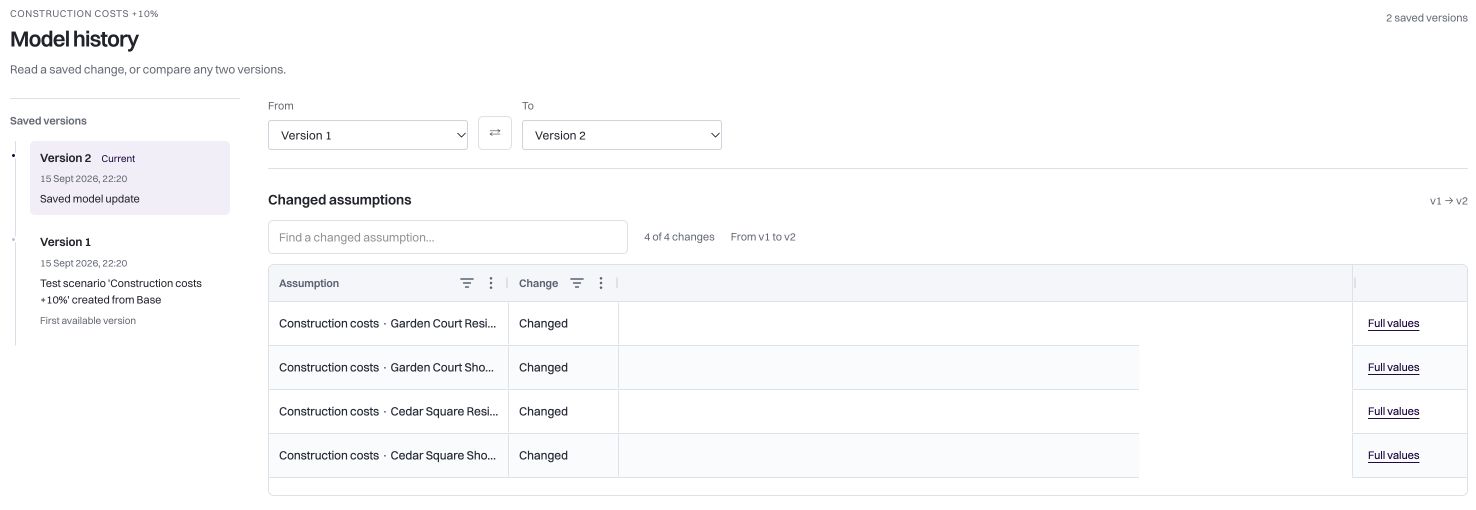
Inspect the four recorded changes
Scroll across to inspect the original capture.
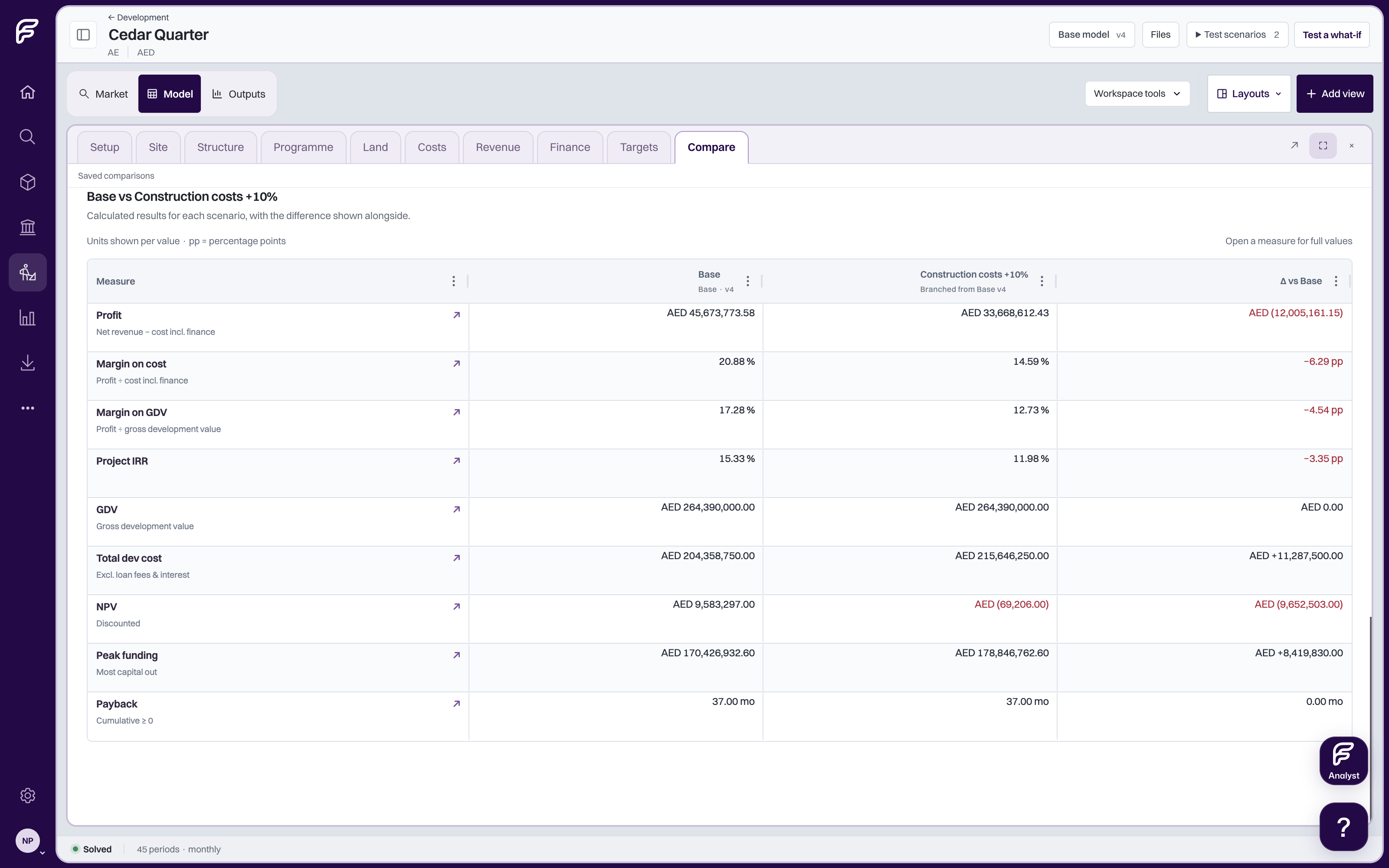
Inspect the saved comparison
Scroll across to inspect the original capture.
- Connected project economics
- Funding through the project lifecycle
- Scenario, sensitivity and probability analysis
 01
Model the project economics.
Connect land, construction, fees and programme with sales and collections, or rental income and exit assumptions. Bring reviewed quantities from your plot and building proposals into the relevant model inputs, then follow the financial effect through the project.
 02
Include the funding.
Model equity and debt, including construction-to-permanent refinancing. Examine interest cover and how funding requirements change over time. Test the land value against a target return to understand what the project can support.
 03
Compare and test.
Compare a what-if with Base, your main model. Use sensitivity analysis to see which assumptions move the result most. Run Monte Carlo analysis on Base to explore a distribution of outcomes as selected assumptions vary together.
Set the project country and reporting currency to give your appraisal its context.
What the Calculation Engine adds.
What is a real estate financial calculation engine?
A financial calculation engine applies defined methods to model inputs and produces financial results. The Feasly Calculation Engine connects development costs, programme, sales or income and supported funding structures. It calculates the cash flow behind profit, capital requirements and returns. The application gives you ways to inspect and change the case; the optional Analyst helps you work with it in conversation.
Why use the engine if AI can generate spreadsheet formulas?
Generating formulas is one step in building a model. You still need a consistent treatment of timing, funding and returns, plus checks when the case changes. In Feasly, the Analyst proposes supported actions for your review and the Calculation Engine calculates the accepted model. That gives the conversation a financial model to work with. It does not establish that every input or method is appropriate: reconcile a known case, inspect the cash flow and investigate differences before relying on the result.
Can I check a calculation before discussing the full platform?
Yes. Our published UK residential example includes five defined cases, engine inputs, results and monthly cash-flow downloads. It shows the separate effects of lower sales, higher construction costs and delayed receipts. The free calculator provides a narrower first screen. Neither that tool nor the all-equity example demonstrates every funding structure or replaces a project-specific appraisal.
Can I use the Calculation Engine in my own software?
Discuss the model types, financial methods and calculation outputs your system needs. Standalone engine access, APIs, compatible MCP connections and private deployment are part of our developing offer. Agree the available operations, versions, access and support for the assignment before designing an integration.
How does Feasly compare with EstateMaster, ARGUS Developer and Aprao?
Compare the supported financial methods, the work needed to change and review a case, and the connections your team needs. Our comparisons link to vendor product information and Feasly examples, including a worked appraisal and the ChatGPT integration. Use a representative project to establish whether Feasly improves the assignment you need to complete.
Site & Design Connect a building proposal with its quantities and economics.
Workspace Keep assumptions, alternatives and results in view.
From the library

Underwrite an office acquisition
Explore four calculated cases: switch vacancy and exit yield to see the effect on cash flow and equity returns.
6 min read
Choose modelling software
Match the software to development cash flow, acquisition underwriting or market research.
8 min read
Compare development software
Compare Feasly, EstateMaster, ARGUS Developer and Aprao against the work your team needs to do.
4 min read