What to take into your next appraisal
- Cost allocation explains who bears a cost; it does not establish when cash is paid.
- Keep shared packages visible and include each external payment once in the consolidated model.
- Test later phases and shared dependencies together before assuming early receipts fund expansion.
Define the package and the phases it serves
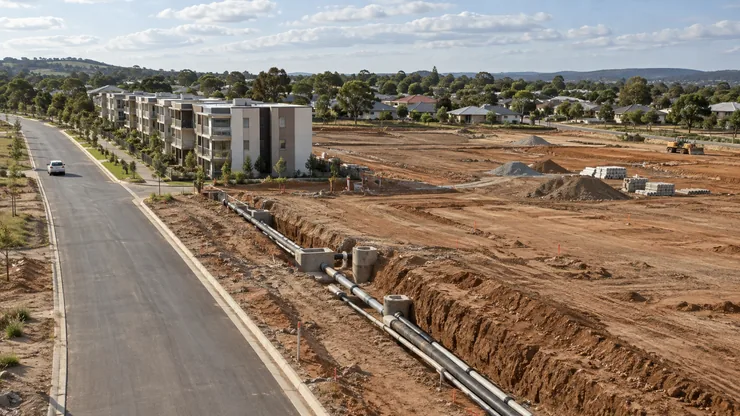
Start with a package register covering roads, utilities, drainage, public realm and other works shared across the proposal. For each package, record its scope, delivery party, beneficiaries, required completion milestone and cost evidence. Distinguish common infrastructure from work that serves only one phase. A building connection and a site-wide trunk network may be different packages even when both appear under utilities.
ICMS 3 supports reporting at project and sub-project level. Its guidance allows common costs to remain separately visible for later reallocation and calls for avoiding omissions and duplication. That is a useful structure for an appraisal: retain a shared-cost record, then explain how it contributes to each phase. A classification framework does not decide the legal payment responsibility or the commercial allocation for the particular development.
Choose an allocation basis that answers the review question
A cost may be allocated by serviced area, capacity demand, unit count, a contractual formula or another stated basis. Choose it for a reason and record which question it answers. Allocating a drainage package by hydraulic demand could tell a different story from allocating it by forecast sales value. Neither choice should silently replace the actual supply agreement or determine a tax or accounting treatment.
Consider an invented two-phase development. Direct phase costs are 8 million for A and 10 million for B. A common package costs 6 million. An assumed 40:60 allocation attributes 2.4 million to A and 3.6 million to B. Against receipts of 12 million and 18 million, the phases show surpluses of 1.6 million and 4.4 million. Reallocating the common cost changes that split, not the combined surplus of 6 million.
| Illustrative allocation, millions | Phase A | Phase B | Combined |
|---|---|---|---|
| Direct costs | 8.0 | 10.0 | 18.0 |
| Allocated common costs | 2.4 | 3.6 | 6.0 |
| Total attributed costs | 10.4 | 13.6 | 24.0 |
| Receipts | 12.0 | 18.0 | 30.0 |
| Surplus before excluded items | 1.6 | 4.4 | 6.0 |
Schedule the actual external payments
The common package may need to be built before either phase generates cash. Create its payment schedule from procurement and contract assumptions: deposits, progress payments, retention and completion obligations. Then connect the relevant milestones to the phase programmes. A later phase receiving most of the benefit does not imply that its share can be paid later.
RICS development-property guidance describes explicit period-by-period cost and receipt assumptions and the need for an appropriate cost-phasing profile. Use the programme and commercial terms to build that profile. A standard curve can be an early assumption, but it should not overwrite a known advance payment or an off-site connection deadline. Keep the allocation table and the payment schedule as separate views of the same package.
Follow the consolidated cash through the example
Assume the 6 million common package is paid 4 million in Q1 and 2 million in Q2. Phase A costs 4 million in each of those quarters. Phase B costs 2 million in Q2 and 4 million in each of Q3 and Q4. A collects 12 million in Q3; B collects 18 million in Q4. All movements occur at quarter end, receipts are available immediately, and opening cash is zero.
The lowest quarter-end cumulative balance is negative 16 million in Q2. This is a pre-financing cash gap, not a committed debt facility or an equity forecast after financing. The table excludes land, finance and tax, so it is a teaching example rather than a complete appraisal. Intra-quarter payment ordering could require additional liquidity in a real project.
| Cash movement, millions | Q1 | Q2 | Q3 | Q4 |
|---|---|---|---|---|
| Common package payments | 4 | 2 | 0 | 0 |
| Phase A direct payments | 4 | 4 | 0 | 0 |
| Phase B direct payments | 0 | 2 | 4 | 4 |
| Total payments | 8 | 8 | 4 | 4 |
| Combined receipts | 0 | 0 | 12 | 18 |
| Net cash flow | -8 | -8 | 8 | 14 |
| Cumulative cash before funding | -8 | -16 | -8 | 6 |
Spot the error that makes funding look easier
Suppose someone spreads the allocated common cost across the phases instead of following the contract. They pay A’s 2.4 million as 1.2 million in each of Q1 and Q2, and B’s 3.6 million as 1.8 million in each of Q3 and Q4. Direct payments and receipts stay unchanged. The revised cumulative balances become negative 5.2, negative 12.4, negative 6.2 and positive 6 million.
The apparent funding gap falls from 16 million to 12.4 million, an understatement of 3.6 million. Total cost and final surplus still reconcile, so a totals-only review misses the error. Changing the cost allocation alone cannot deliver that saving. It would require a genuine change in payment terms or scope, with the corresponding delivery consequences evaluated and evidenced.
Test what happens if a phase or connection moves
An integrated schedule should show how activities lead to the milestones they enable. GAO’s schedule guide supports this dependency-based approach. In a development appraisal, ask whether a road, power connection or commissioning step is needed for first occupation, later construction or both. A delay may affect several receipt streams while leaving an early payment obligation intact.
Test a delayed or cancelled later phase explicitly. Can the shared package be reduced, or is the full commitment already unavoidable? Does an unfinished phase create temporary access or maintenance costs for occupied buildings? Compare staging alternatives with the whole cash schedule. A more even allocation of common costs can improve the appearance of one phase without improving the decision to proceed.
Reconcile responsibilities before approving the programme
Record who signs the infrastructure contract, who pays, who may reimburse whom, and what evidence triggers any reimbursement. If separate project entities fund phases, prepare their cash views as well as the consolidated development view. An internal transfer should appear in the relevant entity schedules and eliminate on consolidation; it must not become an additional external cost or new development revenue.
Before approval, reconcile package totals to phase allocations and external payments, and explain all unallocated balances. Confirm that the infrastructure delivery dates support the receipt programme. Preserve the agreed allocation basis, contract assumptions and prior approved case. The reviewer should be able to see both whether each phase bears a defensible share and whether the development can pay its obligations when due.
Sources and further reading
- ICMS: Global Consistency in Presenting Construction Life Cycle Costs and Carbon Emissions, third edition International Cost Management Standards Coalition · Accessed 15 September 2026
- Valuation of development property RICS · Accessed 15 September 2026
- Schedule Assessment Guide: Best Practices for Project Schedules U.S. Government Accountability Office · Accessed 15 September 2026
Published by Feasly. How we prepare our guides. Suggest a correction.